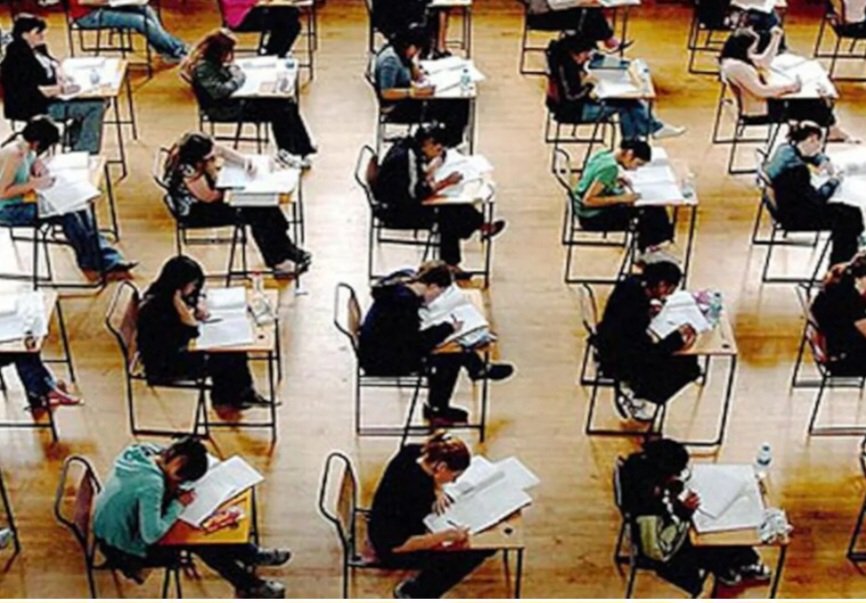
Kota, October 6: The official Joint Implementation Committee (JIC) statistics report for JEE Advanced 2026 has revealed just how challenging this year’s examination was. Out of 1,79,694 candidates who appeared for the exam, only 209 students managed to score full marks in the toughest Mathematics question.
The question was Question No. 9 of Mathematics Paper 1, based on Relations and Functions, particularly equivalence relations. According to the JIC data, 1,17,998 students answered the question incorrectly, while 61,487 candidates did not attempt it. Only 209 students, or 0.12 per cent, secured full marks.
Education expert Kamal Singh Chauhan said the question appeared simple initially, but students struggled with the calculations while attempting it.
Five Most Difficult Questions
The JIC report identified several questions in which less than one per cent of candidates secured full marks:
1. Mathematics Paper 1, Question 9: Only 209 students (0.12%) scored full marks.2. Chemistry Paper 2, Question 15: 988 students (0.55%) scored full marks. The question was based on liquid solutions and gases.
3. Mathematics Paper 2, Question 10: Only 1,175 students (0.65%) secured full marks.
4. Mathematics Paper 1, Question 11: Just 1,298 students (0.72%) solved it completely.
5. Mathematics Paper 2, Question 14: Only 1,804 students (1%) secured full marks.
Only Four Questions Had More Than 50% Full-Marking Rate
The report also showed that only four questions across the examination were answered completely correctly by more than half of the candidates. These included one Chemistry and one Physics question, along with two Mathematics questions, all from Paper 1.
Overall, 26 questions had a full-mark success rate of less than five per cent, highlighting the high level of difficulty of JEE Advanced 2026.
The JEE Advanced 2026 examination was conducted in two papers, covering Physics, Chemistry and Mathematics. Paper 1 had 48 questions, while Paper 2 contained 54 questions, taking the total number of questions to 102.
The JIC statistics provide a detailed question-wise picture of how candidates performed, including the number of students who attempted each question, answered incorrectly, received partial marks or secured full marks.